Trapping Turtles to Save Turtles with the Toronto Zoo
Saim Imran (edited by Miranda Bie)
Posted on 09 Oct, 2020
Native turtle populations in Toronto: Snapping turtles and Blanding’s Turtles
On a bright Saturday morning, Saim Imran, a molecular biology undergraduate from the University of Toronto, pulled out a trap from a swampy pond at his work site and found an ensnared animal hissing at him.
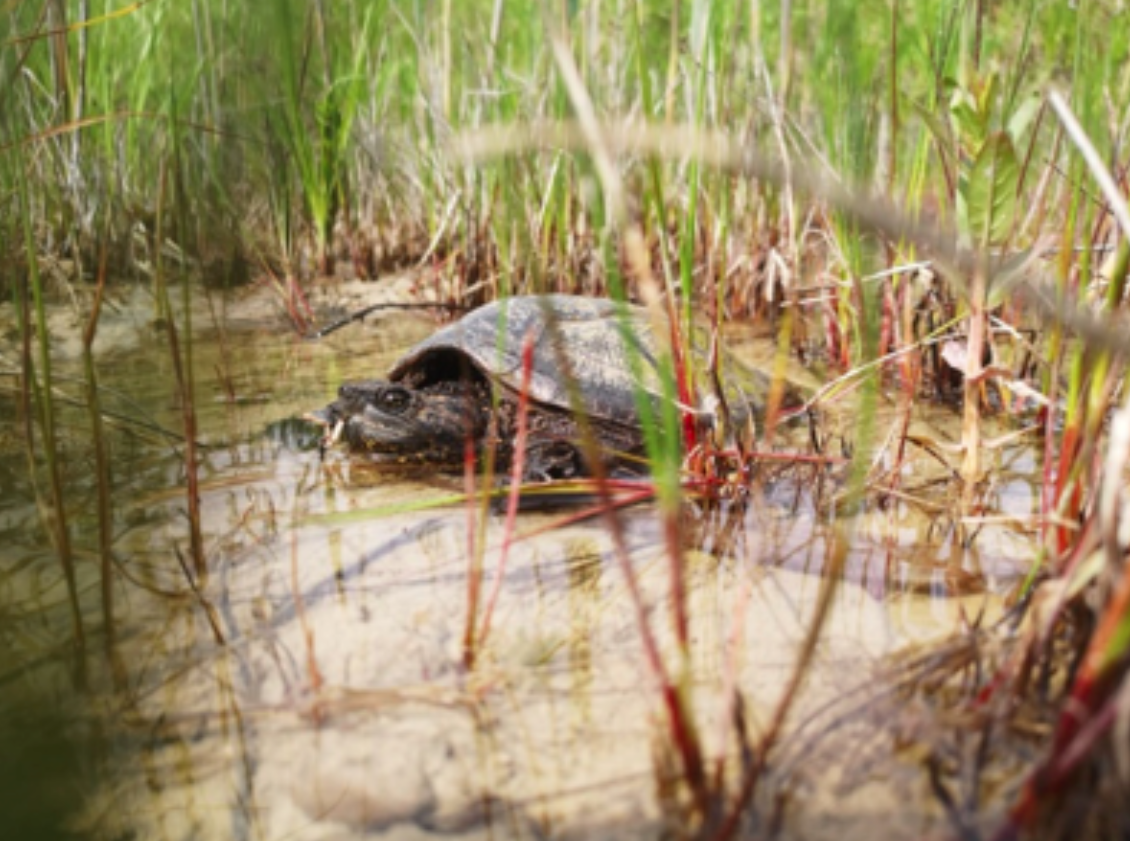
Unlike hunting traps, these traps set by the Toronto Zoo serve the purpose of PIT-tagging animals (inserting a tracking device) for conservation research purposes; this particular trap, for example, provides researchers with the relative distributions of species in the area based on the number of each species caught over time. Upon closer inspection, Saim discovered the captured victim to be a Snapping turtle (Figure 1) recklessly raging to escape. “It's a snapper…,” he sighed. After a long day of finding mostly empty traps, Saim and his team thought that they had struck gold when they saw a turtle struggling to escape, hoping that they had finally caught the elusive and highly endangered Blanding’s Turtle.
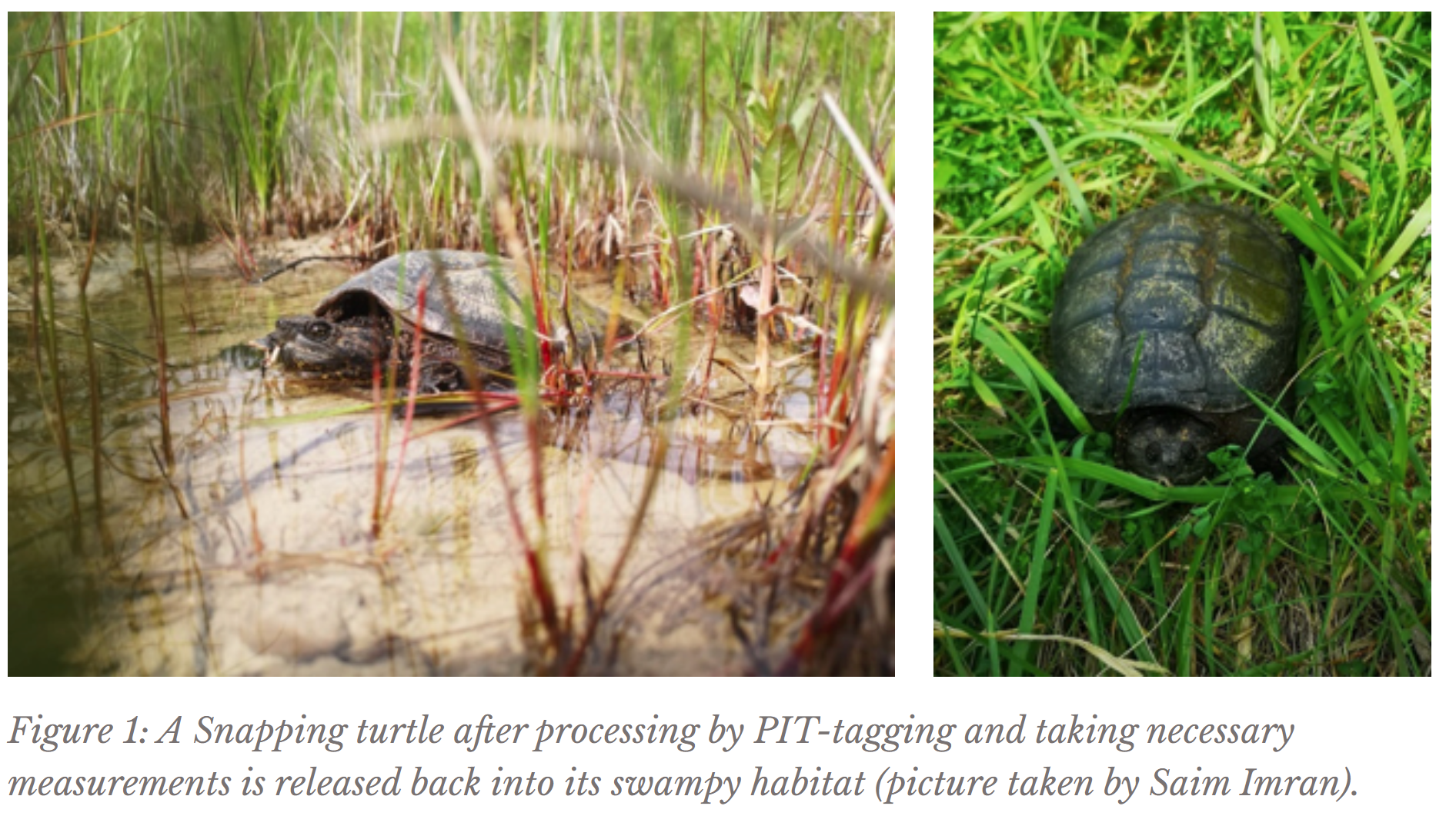
Saim immediately removed the turtle from the trap and processed it with the help of the rest of the Toronto Zoo Adopt-a-Pond team, which was performing a survey of the area in order to restore the natural turtle fauna to wetland habitats in Southern Ontario. Saim’s work location remains undisclosed in order to protect sensitive information on these endangered species. Snapping turtles are known to be the largest turtle species in Ontario, but more importantly for Saim, they are known to have a nasty bite and are difficult to handle. After the team worked together to PIT-tag the turtle and protect each other from losing fingers, they fed it a fish treat for all the trouble and set it free.
Blanding’s Turtle was the species Saim had hoped to catch. Their characteristic yellow underbelly, dome-shaped shell and beautiful yellow speckled pattern across their dark shell make them stand out in an otherwise greenish-brown swamp (Figure 2). These turtles reside in a habitat range centered around the Great Lakes. However, increased urbanization within Toronto has made this once common turtle species along the coast a rarity. Unsurprisingly, urbanization coupled with the invasive introduction of pet turtles in the wild has outcompeted the native Ontario turtle populations (Ritchie and Kula 2011). Additionally, they are often poached for sale as exotic pets due to their ability to live for long periods of time and not show any aging signs (Congdon et al. 2001). Saim and his team are interested in conservation of Blanding’s turtles, which have become one of the most vulnerable species in Ontario, with only 7 members reported in the wild prior to 2014 (Lee et al. 2012).
The Toronto Zoo’s Adopt-a-Pond project: Monitoring conservation efforts
Today, a group of these turtles are hatched and raised at the Toronto Zoo to later release them into the wild for repopulation (Caverhill et al. 2011). The aforementioned Adopt-a-Pond project assesses the success of this re-introduction process. Due to their calmer temperament, unlike Snapping turtles, Blanding’s Turtles often become easy targets for predators such as dogs, cats or raccoons. Urbanization and construction of park trails around the turtles’ habitats have brought these predators close to Blanding’s turtles and their eggs. Hence, Saim’s team researches measures that allow a healthy increase in their population.
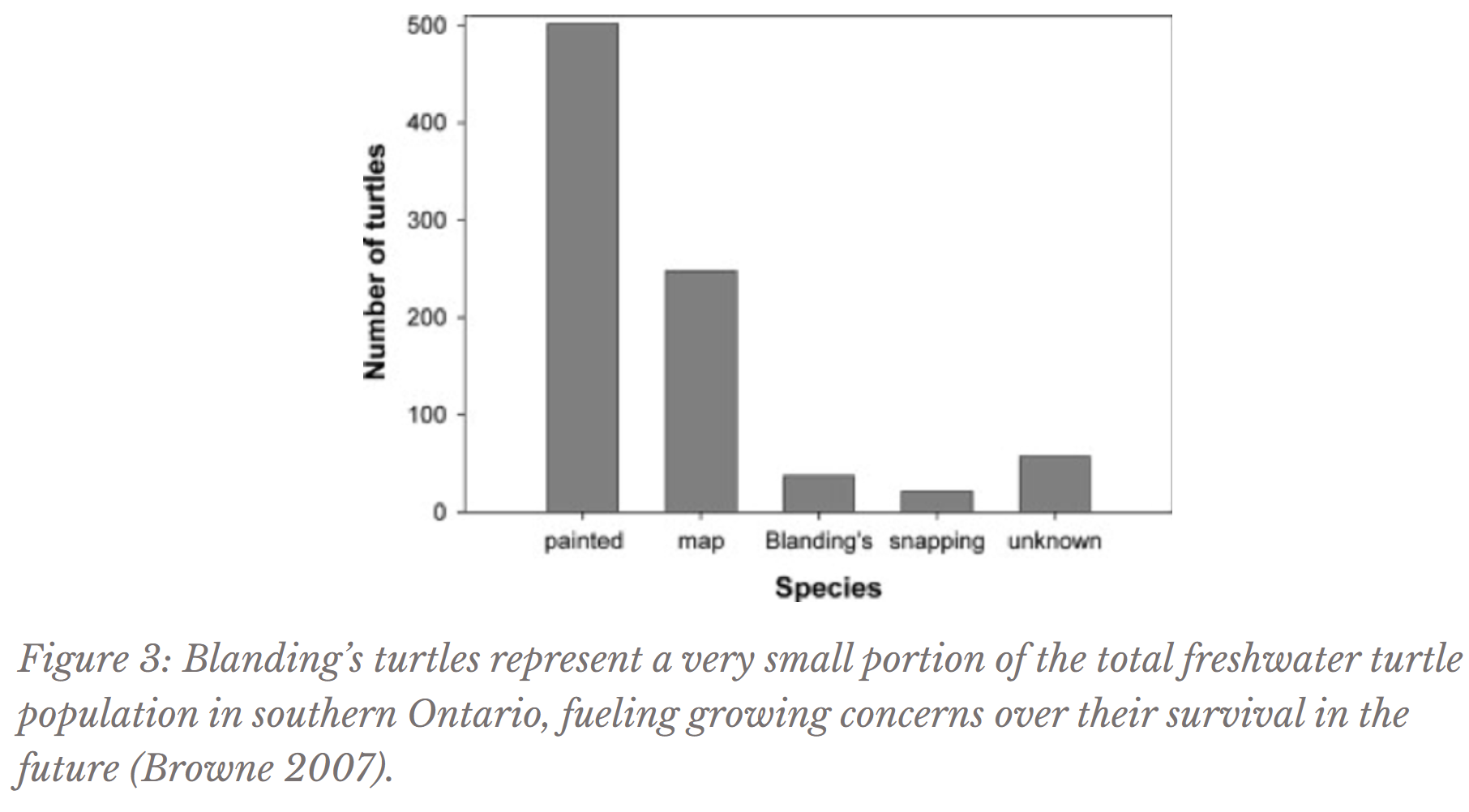
Saim is researching the impact of urbanization on these turtle species. The Toronto Zoo set up research traps in swamp regions around the GTA to track the diversity and population of turtle species. These traps are designed to cause as little harm as possible to the turtles, providing them with a ledge for air and some fishy treats (even though the smell of sardines on a hot and humid July morning is possibly the worst odor a human can smell). The traps are checked daily and the food inside replaced daily. Most of the time, there would either be no turtles inside or the occasional one that manages to crawl in, eat the treats, and escape. Otherwise, the most often-caught specimen is the painted turtle, known for its slightly domed but colourful, seemingly painted shell. Much rarer are Snapping turtles, which would be found only once out every five catches. Blanding’s Turtles are almost never caught. According to a 2007 study on the population of southern Ontario turtle species, Blanding’s Turtles are more common than Snapping turtles (Figure 3). The fact that the Toronto Zoo rarely finds Blanding’s Turtles today is a testament to their severely declining numbers.
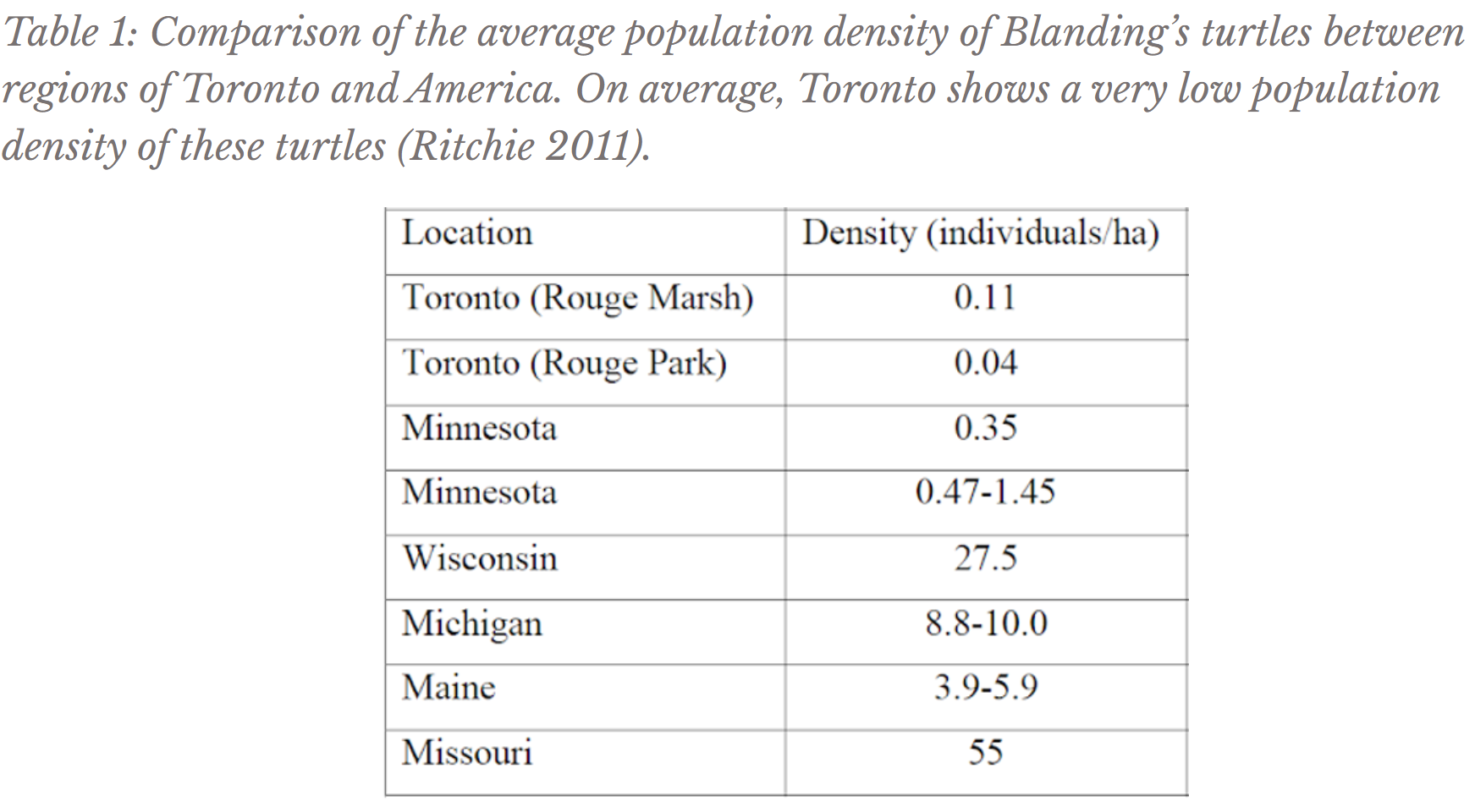
After catching a turtle, Saim and the Toronto Zoo team inject a PIT tag into the animal. A PIT tag is a radio transponder, which allows the turtles to be identified without affecting their fitness. This allows researchers to check whether the same turtle is re-entering the traps; re-captured turtles needed to be subtracted from the final count before determining the possible population density of these turtles. The relative populations of Blanding’s Turtles in Toronto and nearby American states were published in 2011, which show a strikingly low number of turtles in the Toronto region when compared to US counterparts (Table 1). Saim and his team are therefore monitoring the progress of the conservation effort that is so evidently urgent.
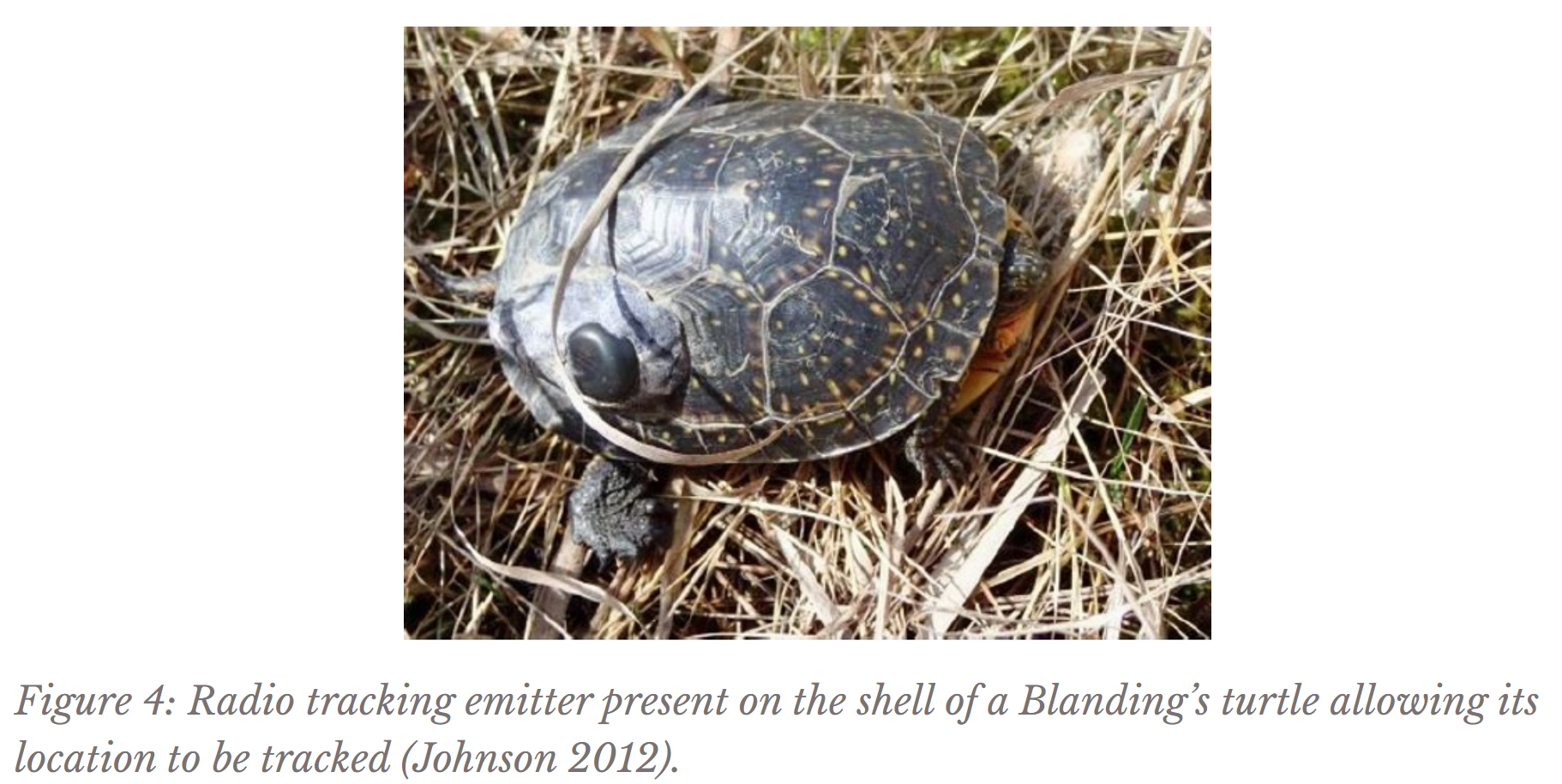
Radio tracking and trapping of turtles (as part of PIT tagging) were performed using radio-telemetry equipment to track turtle movements and determine their nesting grounds and hibernation sites within 3 undisclosed locations. Attached onto turtle shells were radio transmitters, often designed to blend in with the shape, colour, and texture of the shell to avoid affecting the turtle’s fitness (Figure 4). Researchers do not wish to affect the animal’s Darwinian fitness, determined by the degree to which an individual can survive to reproduce, and attaching a conspicuous transmitter may interfere with the turtle’s ability to escape predators or find a mate. A radio receiver was then set at the swamp in which the turtle was released, so the turtle’s movement is tracked when a signal is picked up from the transmitter on the turtle, indicating its location in GPS coordinates. The range of their movement can be used to establish their habitat.
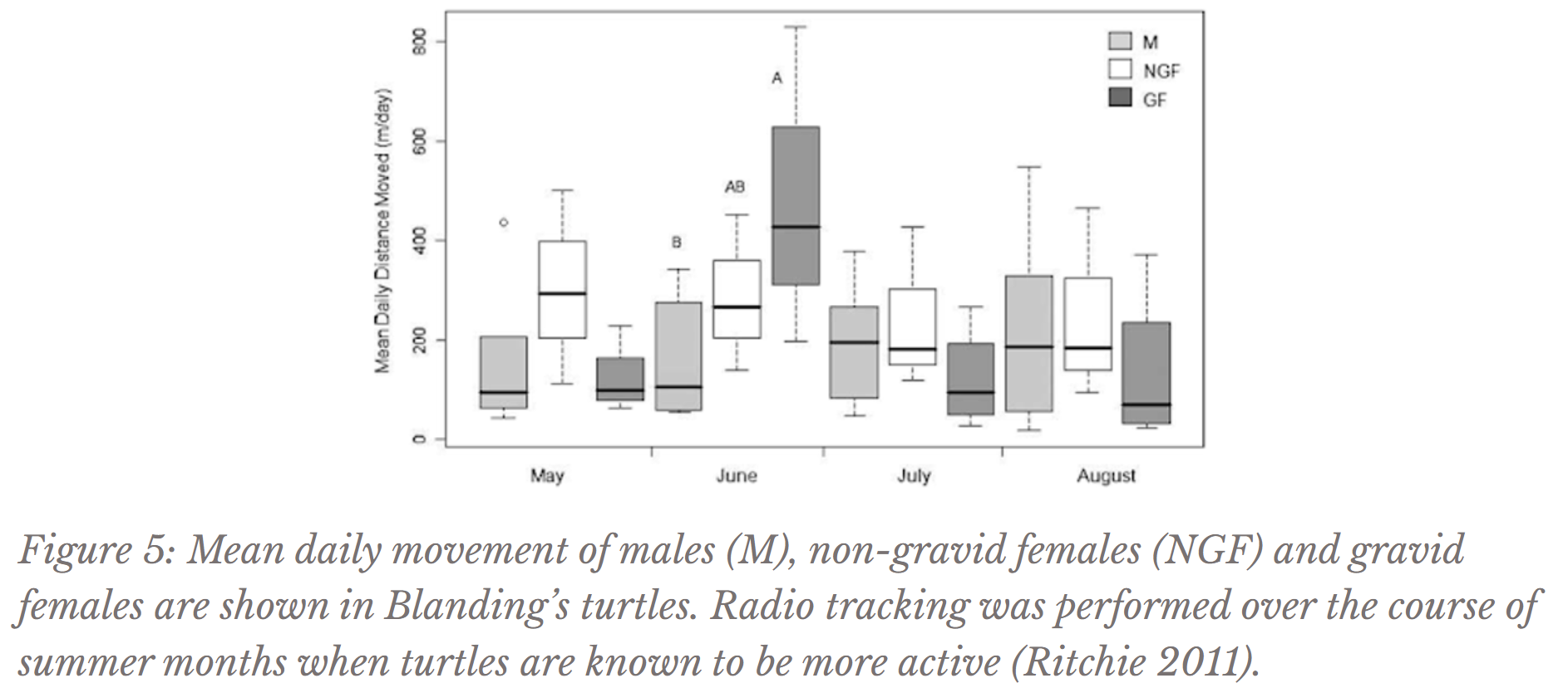
A summary of the mean distance moved over three months for males, gravid females, and non-gravid females (gravid means that female is carrying eggs) as determined in a 2011 study is shown in Figure 5. This information is important for conservation efforts as this can be used to determine regions of their habitat that are far enough away from the city and its dangers (attack by household pets, road activity, and garbage pollution). Small wetlands and seepage areas (or sites where water slowly leaks out of a larger reservoir) were determined to be important components of these turtles’ habitat. This data collected was used to inform the Turtle Management Plan, which aims to increase significant turtle habitats by mapping the current distribution of turtle habitats to determine targets for building new nesting areas (Johnson 2012, Arata et al. 2007). The plan will help create successful artificial nesting sites in areas where traditional sites have been destroyed. These habitats will be monitored for turtle habitation in subsequent years.
From all the data collected, we hope to advance conservation efforts by constructing protection sites, and we hope to find optimum ways of reintroducing suitable habitats. Trapping turtles was conducted to check for an increase in their population to determine whether our strategy is working to protect vulnerable species. Further research on these turtles’ interactions with predation, climate change, invasive species, urbanization, and poaching is needed to improve current habitats for these turtles. For example, release of non-native pet turtles into swamps has led to out-competition of the Blanding’s turtles for food and rise in global temperatures is inducing the migration of many parasites Northward into Canada, which increases rates of infectious diseases. Hence, picking good habitats for the release of native turtle species requires extensive research into the multitude of factors that affect their survival.
References:
Arata J, Cox C, Ireland D, Johnson B, Lawton, M, Marcks H, Seabrooke S, Nelson M. 2007. Turtle field research in the Rouge Park, 1999-2006: Snapping Turtle, Northern Map Turtle, and Blanding's Turtles. Toronto Zoo, Adopt-A-Pond Wetland Conservation Programme. Toronto, ON
Browne CL, Hecnar SJ. 2007. Species loss and shifting population structure of freshwater turtles despite habitat protection. Biological Conservation. [accessed 2020 Jul 20];138(3–4):421-429. https://www.sciencedirect.com/science/article/pii/ S0006320707002261 doi:10.1016/j.biocon.2007.05.008
Caverhill BP, Johnson B, Phillips J, Nadeau E. 2011. Blanding's Turtle (Emydoidea blandingii) and Snapping Turtle (Chelydra serpentina) habitat use and movements in the Oakland Swamp Wetland Complex, and their response to the Provincial Highway 24 Exclusion Fence and Aquatic Culvert Ecopassage. Toronto Zoo, Adopt-A-Pond Wetland Conservation Programme. Toronto, ON.
Congdon JD, Nagle RD, Kinney OM, van Loben Sels RC. 2001. Hypotheses of ageing in a long-lived vertebrate, Blanding’s turtle (Emydoidea blandingii). Exp Gerontol 36(4–6):813–827
Johnson B. 2012. Personal Interview. Toronto Zoo, Adopt-A-Pond Wetland Conservation Programme. Toronto, ON.
Lee R, Ritchie SD, Phillips J, Johnson B. 2012. Rouge park Blanding’s Turtle Headstart initiative. Toronto Zoo, Adopt-A-Pond Wetland Conservation Programme. Toronto, ON.
Ritchie S, Kula M. 2011. Identifying wetland restoration opportunities for recovery of species at risk turtles in Rouge Park. Toronto Zoo, Adopt-A-Pond Wetland Conservation Programme. Toronto, ON.