Opening Pathways in the Treatment of Alzheimer’s Disease (Advanced Read)
Kanza Mirza, Arabie Sathivel, and Mary Bernadette Villareal (edited by Seliya Mawani, Miranda Bie)
Posted on 09 Jan, 2021
What is Alzheimer’s disease?
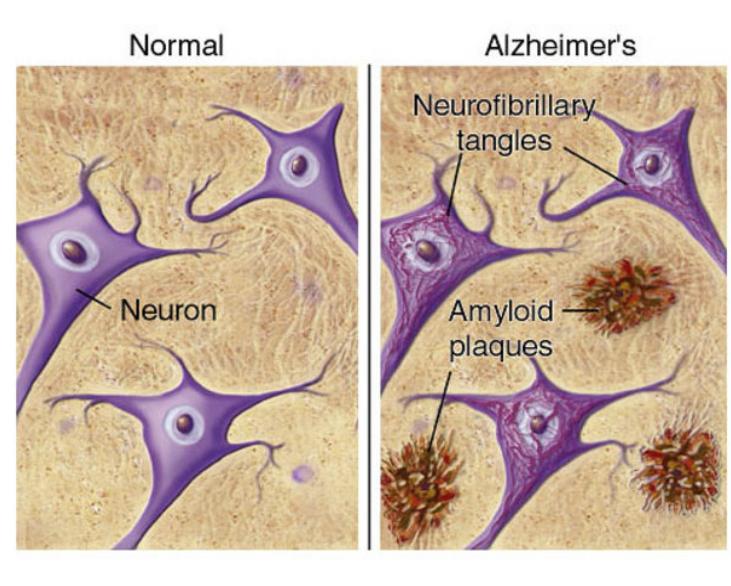
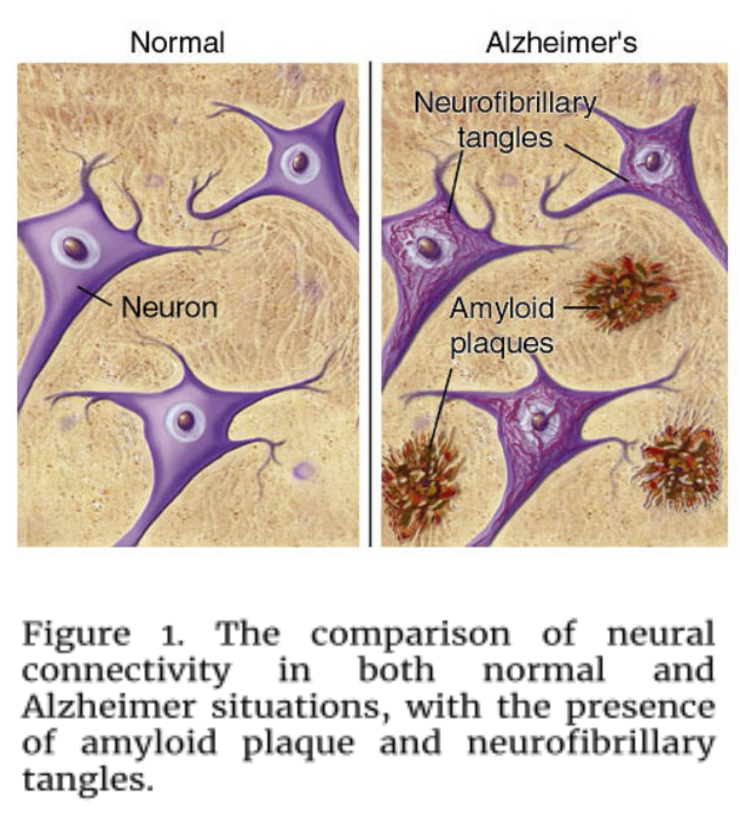
Alzheimer’s disease (AD) is one of the most common causes of dementia, with a diagnosis of approximately 44 million people worldwide. This number is projected to reach 100 million by 2050. Despite the prevalence of the disease, there is no cure and scientists are still in pursuit of finding the most feasible and optimal treatment option. Alzheimer’s disease is characterized by insoluble protein plaque deposits, which are abnormal clumps of protein that disrupt signaling between neurons, and neurofibrillary tangles which ultimately result in neuronal death (see Figure 1). Current treatments mainly only focus on treating the symptoms, but progressive treatments and improved methodology to gain access to these diseased areas of the brain are continuously being discovered. One obstacle to treatment is the blood-brain barrier, which prevents both exposure to harmful chemicals and the delivery of medicine to the brain, imposing size and biochemical restrictions for molecules.
What causes Alzheimer’s?
β-amyloids are misfolded proteins originating from the breakdown of normal precursor proteins. These proteins amass together and form plaques (or insoluble clumps) that disrupt signalling in the brain and induce the phosphorylation of tau proteins. Neurofibrillary tangles are formations of hyperphosphorylated tau proteins that become tangled inside neurons. The accumulation of these plaques and tangles can lead to the disruption of neuronal communication, inflammation of the brain, and cell death. They are also the driving force behind why Alzheimer patients lose memory and cognition as they get older.
Microbubbles: A solution in progress
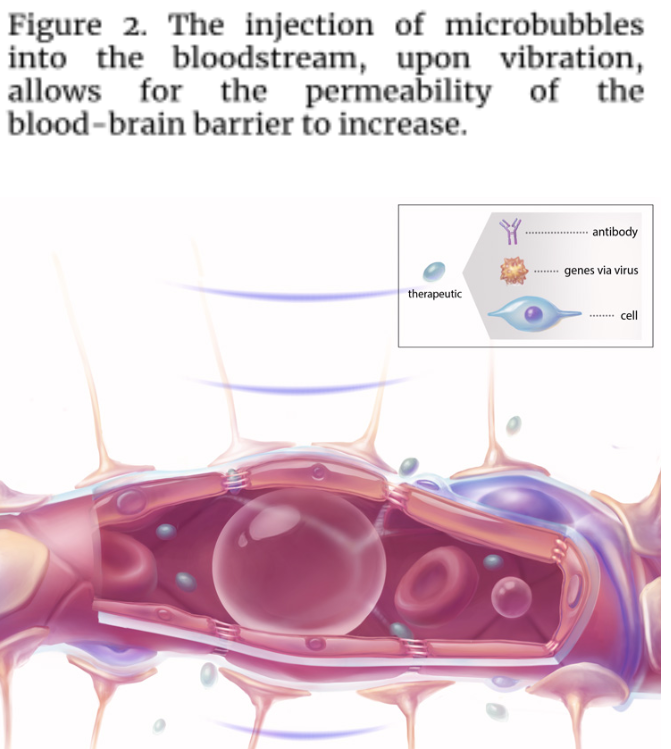
Researchers at the Sunnybrook Research Institute (associated with the University of Toronto) display a new avenue of treatment for brain diseases, a method that involves using small gas-filled bubbles (microbubbles) and MRI-guided focused ultrasound to reversibly and non-surgically widen blood vessels, increasing their permeability. By changing vessel permeability through the vibration of microbubbles, antibodies (immune system proteins) can temporarily pass through the blood-brain barrier and call the immune system to destroy the β-amyloid and hyperphosphorylated tau. This disruption itself has shown to increase brain growth, prevent spatial memory deficits, and reduce plaque burden.
Aducanumab: A temporary solution
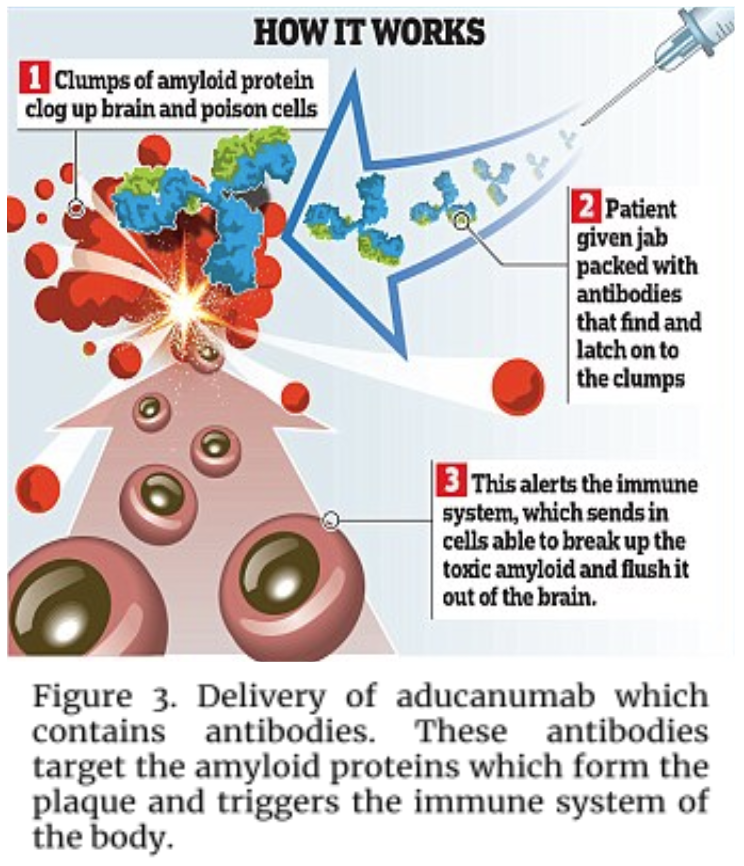
Current treatments only treat the symptoms of Alzheimer’s rather than the cause. But research from Sevigny J et al (2016) provided hope for medication with disease-modifying benefits. Early research in 2013 found that amyloid plaque induces the phosphorylation of tau (the cause of neurofibrillary tangles), which then spreads through the brain and leads to neuronal death. Aducanumab is a human antibody that targets and removes clustered masses of β-amyloid plaque, slowing the decline in memory and thinking ability in people with AD. However, recent trials in antibody administration suggest that by the time early symptoms of AD arise, it may be too late to use this treatment as β-amyloid plaques are no longer driving the disease; rather the tau neurofibrillary tangles are. So overall, β-amyloid plaques only drive the phosphorylation of tau at the beginning of AD.
Phosphorylated tau (neurofibrillary tangles) are triggered when the plaque accumulates and are a direct cause for the symptoms associated with the disease. Drugs targeting over-phosphorylated tau are also in development. New treatments are being developed to prevent the accumulation of neurofibrillary tangles in the hippocampus and spinal cord. For example, the administration of lithium decelerates the rate of phosphorylation of tau proteins while minimizing the levels of tau proteins already present.
Hope for the future
Combining the treatment of both antibody and chemical approaches provides new treatment directives and addresses the limitations of current treatments. This provides hope for future Alzheimer’s treatments, as patients currently face a life expectancy of only 4-8 years after prognosis. We envision that progressive research by future generations will improve the quality of life and life-span of these patients, with hopes of providing a viable therapy option to those in need.
Glossary
- Aducanumab: human antibody that targets and removes clustered masses of β-amyloid plaque
- Antibodies: proteins secreted by immune cells that target and bind to foreign substances in the body; signals other immune cells to destroy the target
- β-amyloids: misfolded proteins originating from the breakdown of normal proteins
- Blood-brain barrier: selective barrier that protects the brain from exposure to harmful chemicals that may be in the bloodstream
- Hippocampus: a part of the brain responsible for learning and memory
- Hyperphosphorylated: the state of a compound when all available phosphorylation sites are fully phosphorylated; can alter the function of a molecule
- Lithium: an alkali metal that is typically administered to aid in the reinforcement of nerve cell signaling which promotes mood and behaviour regulation
- Microbubbles: extremely small gas filled bubbles (about one hundredth of a millimeter) that resonate at high frequencies (such as ultrasound waves)
- MRI-guided focused ultrasound: noninvasive method that uses magnetic resonance imaging (MRI) to selectively target a location for ultrasound wavelength delivery
- Neurofibrillary tangles: formations of hyperphosphorylated tau proteins that become tangled inside neurons
- Neurons: cells found within the brain and nervous system that are responsible for transmitting information
- Permeability: quality of a membrane (of a cell) for allowing substances to pass through
- Phosphorylation: the addition of a phosphate group to a molecule (critical for cellular processes)
- Protein plaque deposits: abnormal clumps of protein that are unable to be dissolved
- Tau proteins: proteins that are required for the stability of neurons and are abundant in the brain and spinal cord
References
Alzheimer's & Dementia Help: Canada. N.d. [accessed 2020 Sept 16]. https://www.alz.org/ca/dementia-alzheimers-canada.asp
Fagan T. 2019, March 21. Biogen/Eisai Halt Phase 3 Aducanumab Trials. Alzforum. [accessed 2020 Sept 16]. https://www.alzforum.org/news/research-news/biogeneisai-halt-phase-3-aducanumab-trials
Leroy K, Ando K, Héraud C, Yilmaz Z, Authelet M, Boeynaems JM, Buée L, De Decker R, Brion JP. 2010. Lithium treatment arrests the development of neurofibrillary tangles in mutant tau transgenic mice with advanced neurofibrillary pathology. Journal of Alzheimer's disease: JAD. 19(2): 705–719. https://doi.org/10.3233/JAD-2010-1276
Lipsman N, Meng Y, Bethune AJ, Huang Y, Lam B, Masellis M, Herrmann N, Heyn C, Aubert I, Boutet A, Smith GS, Hynynen K, Black SE. 2018. Blood-brain barrier opening in Alzheimer's disease using MR-guided focused ultrasound. Nature communications. 9(1): 2336. https://doi.org/10.1038/s41467-018-04529-6
Macrae F. 2016, Aug 31. Could this be the end of Alzheimer's? Revolutionary drug 'may stop the disease from ever developing. The Daily Mail. [accessed 2020 Sept 16]. https://www.dailymail.co.uk/health/article-3767488/Is-cure-Alzheimer-s-sight-Unprecedented-trial-sees-drug-clear-toxic-proteins-brain.html
Malik GA, Robertson NP. 2017. Treatments in Alzheimer's disease. Journal of neurology 264(2): 416–418. https://doi.org/10.1007/s00415-017-8395-1
Naqvi E. 2017, June 30. Alzheimer's Disease Statistics. Alzheimer’s News Today. [accessed 2020 September 16]. https://alzheimersnewstoday.com/alzheimers-disease-statistics/
Noble W, Planel E, Zehr C, Olm V, Meyerson J, Suleman F, Gaynor K, Wang L, LaFrancois J, Feinstein B, et al. 2005. Inhibition of glycogen synthase kinase-3 by lithium correlates with reduced tauopathy and degeneration in vivo. Proceedings of the National Academy of Sciences of the United States of America. 102(19): 6990–6995. https://doi.org/10.1073/pnas.0500466102
Sevigny J, Chiao P, Bussière T, Weinreb PH, Williams L, Maier M, Dunstan R, Salloway S, Chen T, Ling et al. 2016. The antibody aducanumab reduces Aβ plaques in Alzheimer's disease. Nature. 537(7618): 50–56. https://doi.org/10.1038/nature19323
Snow AD, Castillo GM, Nguyen BP, et al. The Amazon rainforest plant Uncaria tomentosa (cat’s claw) and its specific proanthocyanidin constituents are potent inhibitors and reducers of both brain plaques and tangles. Sci Rep 9. 561 (2019). https://doi.org/10.1038/s41598-019-38645-0
Focused Ultrasound - Preclinical Research. N.d. Sunnybrook Research Institute. [accessed 2020 September 16]. https://sunnybrook.ca/research/content/?page=sri-centres-focused-ultrasound-preclinical
Weller J, Budson A. 2018. Current understanding of Alzheimer's disease diagnosis and treatment. F1000Research 7, F1000 Faculty Rev-1161. https://doi.org/10.12688/f1000research.14506.1