Environmental DNA at UTSC: Be on the Lookout
Elizabeth Patterson (edited by Anindro Bhattacharya)
Posted on 02 Jan, 2023
Introduction to Environmental DNA
Environmental DNA (eDNA) is the genetic material shed by organisms through natural functions, such as excretion, into the environment (Wang et al., 2021). Commonly collected from aquatic environments, eDNA can be used to detect the presence of a species of interest (Wang et al., 2021). With the use of this detection, species presence and abundance can be monitored for further implications into environmental health and ecology (Wang et al., 2021).
eDNA at the University of Toronto
The Lovejoy Lab at the University of Toronto Scarborough Campus is currently using eDNA to detect the presence of Canadian fish species of interest. Amongst these fish is the Deepwater Sculpin, Myoxocephalus thompsonii (Figure 1), a Canadian freshwater deep-lake adapted fish (Sheldon et al., 2008). Due to this fish’s deepwater adaptations, little is known about its ecology and conservation status (Sheldon et al., 2008). However, if its presence can be detected using eDNA samples, we may gain more insight into this fish’s whereabouts and conservation status.
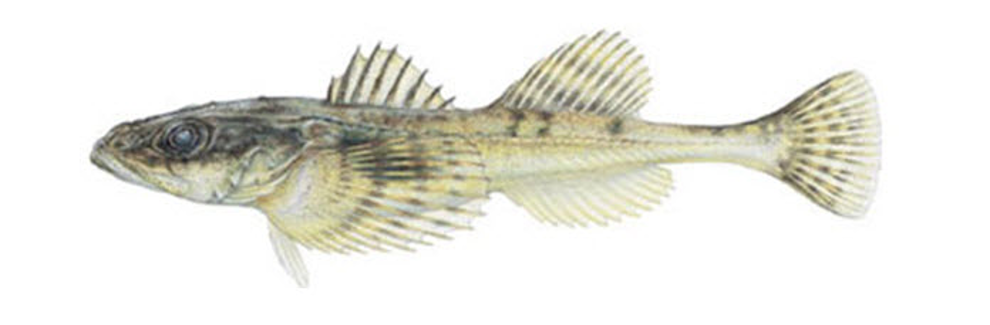
Figure 1: The Deepwater Sculpin, Myoxocephalus thompsonii (Government of Canada, 2017).
To do this, researchers target deep Canadian lakes where the Deepwater Sculpin may be present. Sample collection is conducted by taking numerous water samples from different depths and locations of the lakes and pushing that water through a filter that the eDNA will be collected on (Rees et al., 2014). The filter is then digested and the eDNA is isolated using molecular DNA extraction techniques in the lab (Rees et al., 2014). To detect a species of interest, a series of primers, short complementary sequences to the species’ DNA, must first be designed that will attach to and amplify that species, and only that species, DNA sequence in that eDNA sample. This amplification process is where the DNA sequence of the species is duplicated several thousand times in order to visualize that DNA for the human eye. To design a species-specific primer, the sequence of that species’ DNA and closely related fish’s sequences will be aligned at a gene of interest on a computer software program. Researchers must find areas where the species of interest’s DNA sequence differs from the other sequences, so the designed primer will not bind to the non-targeted species sequences.
Once designed, the primers are added to a mixture with the eDNA samples and placed in a thermocycler, where the PCR process will take place. To determine if the species DNA amplification was successful and the species’ DNA was present in the eDNA sample, the amplified product will come out of the thermocycler and will be pipetted into a gel for gel electrophoresis. In the process, this gel is hooked up to an electrical source, where electricity is slowly sent through the gel, and the DNA will travel toward the positive electrical signal since DNA has an overall negative charge. If successful, a band will be observed on the gel that has travelled toward the positive electrical signal, indicating DNA has been amplified. This DNA is then purified from any remaining debris from the amplification step, and sent to a lab to be sequenced, ensuring that the species of interest’s DNA was amplified instead of another species.
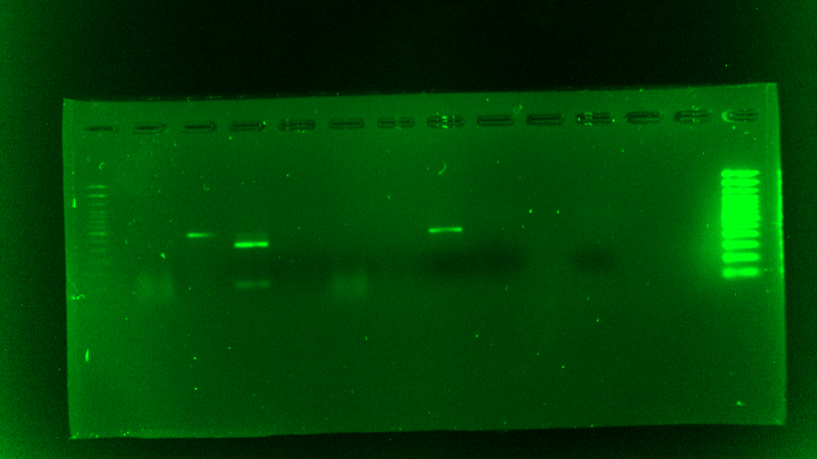
Figure 2: An image of a gel after gel electrophoresis. The light bands toward the middle of the gel indicate that DNA has been amplified.
Implications Using eDNA
Now you may be asking why this research and extended process of eDNA sampling is important. The collection and sampling of eDNA has further implications in monitoring biodiversity and conservation of species (Harrison et al., 2019). The applications of eDNA span throughout the conservation field, aiding in analyzing the diet of species, parasitic composition and evolution, and even detecting invasive species (Harrison et al., 2019). So, not only can eDNA help detect the presence of aquatic species of interest, but it can also aid in a variety of conservation monitoring as well (Harrison et al., 2019). Currently, eDNA is being tested on its accuracy in determining the abundance of a species of interest in an aquatic environment, an incredibly helpful tool if successful, especially for bottom-dwelling species like the Deepwater Sculpin (Sheldon at al., 2008; Harrison et al., 2019).
The use of eDNA should be on every conservationist’s radar as it’s a growing sampling method with increasing efficiency and accuracy. To follow along on the Lovejoy Lab’s journey with eDNA, email elizabeth.patterson@mail.utoronto.ca for inquiries and updates. Also check out this short video on the recent research conducted on the Deepwater Sculpin by the Lovejoy Lab: https://fb.watch/g9rtjguu2B/
References:
Harrison, J.B., Sunday, J.M. and Rogers, S.M., 2019. Predicting the fate of eDNA in the environment and implications for studying biodiversity. Proceedings of the Royal Society B. [2019 Nov 20; accessed 2022 Oct 14]. Available at: https://doi.org/10.1098/rspb.2019.1409
Government of Canada. 2017. Deepwater sculpin (Myoxocephalus thompsonii) some populations: COSEWIC assessment and status report 2017. [Accessed 2023 Jan 2]. Available from: https://www.canada.ca/en/environment-climate-change/services/species-risk-public-registry/cosewic-assessments-status-reports/deepwater-sculpin-some-populations-2017.html
Rees, H.C., Maddison, B.C., Middleditch, D.J., Patmore, J.R. and Gough, K.C. 2014. The detection of aquatic animal species using environmental DNA–a review of eDNA as a survey tool in ecology. Journal of Applied Ecology. [2014 June 20; accessed 2022 Oct 14]. Available from: doi: 10.1111/1365-2664.12306
Sheldon, T.A., Mandrak, N.E. and Lovejoy, N.R. 2008. Biogeography of the deepwater sculpin (Myoxocephalus thompsonii), a Nearctic glacial relict. Canadian Journal of Zoology. [2008 Feb 18; accessed 2022 Oct 14]. Available at: https://doi.org/10.1139/Z07-125
Wang, Shuping, Zhenguang Yan, Bernd Hänfling, Xin Zheng, Pengyuan Wang, Juntao Fan, and Jianlong Li. 2021. Methodology of fish eDNA and its applications in ecology and environment. Science of the Total Environment. [2021 Feb 10; accessed 2022 Oct 11]. Available from: https://doi.org/10.1016/j.scitotenv.2020.142622